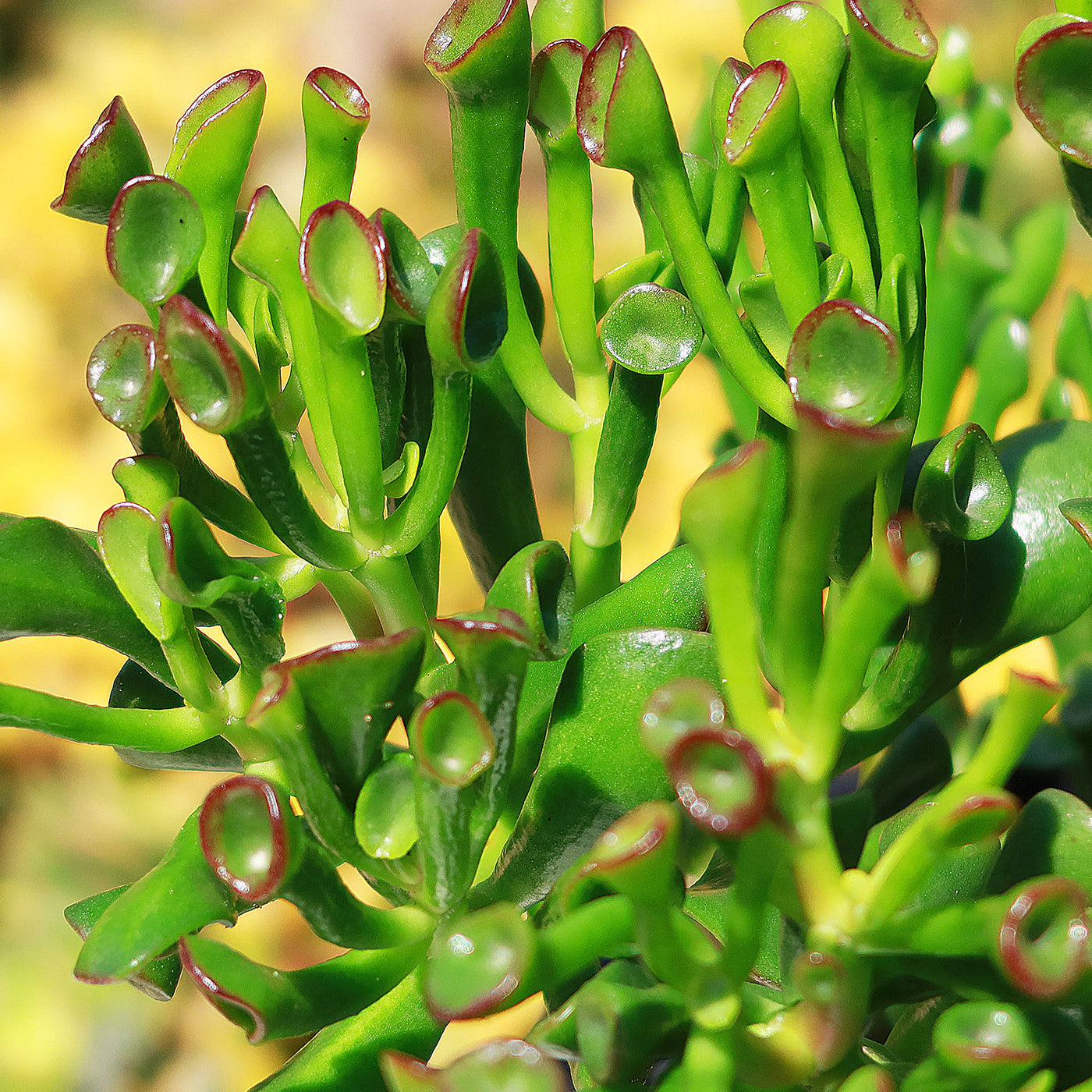
finger jade succulent care ET's Fingers-Shrek Ears 'Crassula ovata Gollum Jade'
SKU: 1492236972
finger jade succulent care

finger jade succulent care ET's Fingers-Shrek Ears 'Crassula ovata Gollum Jade'

Sale price$21.91 Regular price$24.34
Save 10%

Pay in installments of $6.08 with ShopPay, AfterPay and Klarna

Shipping Estimate
USA
  • USA
  • CAN

Ships within 48 hours · Estimated delivery Jul 2 - Jul 7

Promo Codes Available:

For Your Every Summer RSVP, with Code: SUMMER15

Description

finger jade succulent care ET's Fingers-Shrek Ears 'Crassula ovata Gollum Jade'The Gollum jade plant is also known as "ET's Fingers" because its fleshy leaves resemble the alien character's long, pointed fingers in the 1982 film "E. T. the Extra Terrestrial." The tips of the plants also look like the ears of the popular animated character Shrek, hence the other popular name, Shrek Ears. The plant's distinctive appearance has made it a favorite among kids who love the common names and like to look at it and touch it. This Gollum

The Gollum jade plant is also known as "ET's Fingers" because its fleshy leaves resemble the alien character's long, pointed fingers in the 1982 film "E.T. the Extra-Terrestrial." The tips of the plants also look like the ears of the popular animated character Shrek, hence the other popular name, Shrek Ears. 

The plant's distinctive appearance has made it a favorite among kids who love the common names and like to look at it and touch it.  This Gollum jade plant is also easy to care for, which may make it a good choice for families. 

Native to South Africa and Mozambique, these evergreen-flowering golumm jade plants can grow up to 3 feet tall and 2 feet wide and are sure to be the talk of your garden or indoor space.

When exposed to bright light, it produces green finger-like leaves with red circles at the tips. 

The flowers of your plant bloom during the late spring to early winter, with small, pinkish-white, star-shaped blooms. 

The Gollum jade or ET's fingers succulent plant is also considered a symbol of good luck in Chinese culture; that's why sometimes it is also referred to as the money plant.

Taking care of this plant doesn't require any lucky charms. In fact, it's super low-maintenance, easy to keep alive, and pretty.

Crassula ovata ‘Gollum Jade’ is often confused with Crassula ovata ‘Hobbit Jade'Go to jade hobbit plant crassula ovata hobbit due to their similarities and both being named after characters from JRR Tolkien’s stories.  

When and How to Water Your Gollum jade  

Gollum jade plants are extremly drought tolerant requiring minimal watering. It's important to only water them when the soil has dried out, as overwatering can cause root rot. Succulents, including these ET's fingers, are prone to rot if their roots are constantly submerged in moisture. 

The Gollum jade should be watered 10-14 days in growing season and reduce reduce watering to once every 3-4 weeks during the dormant season, with very light moisture.

During the growing season, control watering to allow the soil to dry out completely between waterings to prevent root rot. Good airflow and well-draining soil are also essential to keep the plant healthy and resilient throughout its active growth period.

During the dormant season, reduce watering since excess moisture can easily lead to root rot. Fertilizing is not necessary during this time, as the plant is not actively growing. It is best to keep it in a bright location with indirect sunlight and protect it from cold drafts or temperatures below 10°C, as the plant is sensitive to frost. Keeping conditions stable will help it rest properly and prepare for healthier growth in the next season.

Light Requirements - Where to Place Your Golumm Jade Plant

When growing indoors, providing enough light for these desert ET's fingers is one of the most important aspects of their care.

Place your jade plant directly in front of a west- or south-facing window where it can receive about 4 to 6 hours of direct sunlight daily.

Rotate the plant occasionally to help it grow evenly and keep its tubular leaves compact and well-shaped.

When growing outdoors, it thrives best in a location where it can receive about 4 to 6 hours of direct sunlight daily, with some protection from intense midday sun to prevent leaf burn.

A spot with partial shade during the hottest part of the day works well, especially in warmer climates.

If grown in pots, you can move it to a sheltered area during bad weather. With the right balance of sunlight, your Gollum jade can develop stronger stems and more vibrant leaf color.

Pro Tip

  1. If they don't receive enough light, their stems may grow leggy and become pale green or yellow, so make your succulents happy and give them plenty of light.
  2. If you notice the Gollum jade ET's fingers leaves are turning yellow or brown, it may be a sign that the plant is getting too much direct sunlight.

Optimal Soil & Fertilizer Needs 

The Gollum jade prefers a light, airy, and well-draining soil that is slightly acidic, with a pH between 5.6 and 6.5. Like most succulents, it does best in soil that dries out completely between waterings. A sandy, loose texture is ideal, similar to what you would find in desert conditions. Soil that stays wet for too long can harm the plant, leading to bacterial and fungal rot. 

You can also make your own mix by combining equal parts perlite, coarse sand, and a good-quality potting soil. This blend helps improve drainage while still providing enough nutrients. You can also use our specialized succulents potting mix that includes organic mycorrhizae – perfect for promoting healthy roots and happy plants.

Gollum jade is not a heavy feeder, but it can benefit from light fertilizing during its active growing season. A balanced fertilizer, such as a 5-10-5 NPK formula, works well. Apply it once during spring to support healthy growth. Avoid fertilizing during the dormant months in fall and winter, as the plant is resting and does not need extra nutrients. 

Hardiness Zones & More 

In the United States, this ET's fingers plant is mostly an indoor plant, but if you live in Southern Florida or Hawaii, then you can cultivate it outdoors in USDA zones 9-12.

They prefer constant temperatures above 70°F and can tolerate triple digits in the summer, so don't worry if your succulent gets too hot. 

They cannot handle frost, cold, or freezing temperatures, so make sure it doesn't get below 45°F in its environment. It can be grown as a houseplant in colder climates. ET's fingers prefers average to low humidity environments. These plants are adapted to arid conditions and have thick, fleshy leaves that store water.

So, you don't need to worry too much about providing extra humidity for them. Just make sure the air isn't excessively dry, especially during winter months when indoor heating can reduce humidity levels. 

How to Grow Indoors as a Houseplant 

Your ET's Fingers plant will do best when placed directly in front of a south or west facing window where it can receive around four to six hours of direct sunlight each day. Make sure to let the soil dry out completely before watering again, and avoid leaving the pot sitting in water since this can quickly lead to root rot.

Keep it in a room with average temperatures between 60°F and 75°F for healthy growth. Use a fast draining succulent mix to keep the roots dry and well aerated, and choose a pot with drainage holes so excess water can escape and the soil can dry faster.

Wildlife -  Golumm Jade Flowers Attract the Following Friendly Pollinators 

The Golumm Jade can attract friendly pollinators such as bees, butterflies, hummingbirds, and other beneficial insects. These pollinators play a crucial role in the ecosystem by aiding in the reproduction of plants and ensuring biodiversity.

Butterflies
Bees
Hummingbirds
Lady Bugs
Multi Pollinators
Other Birds

According to ASPCA, the Crassula ovata Gollum Jade is considered mildly toxic to humans or pets. It's always a good idea to practice caution and keep plants out of reach of curious pets or small children. 

How to Propagate Your Gollum Jade - ET's Fingers

You can propagate your Gollum jade (Et's Fingers) by stem cuttings. After cutting the stem, place it in a warm, shaded, and well ventilated area for about 2 to 5 days.

Once ready, plant the stem cuttings directly into a pot filled with a fast draining succulent or cactus mix. Keep the soil lightly moist but not soggy by misting or watering every few days until the cuttings begin to establish roots. Place the plant in bright, indirect light and avoid direct sunlight at this stage to prevent sunburn. 

Key Takeaways

  1. Golumm Jade is known for its tubular, finger like leaves with red tips that resemble ET’s fingers or Shrek’s ears, making it a fun and eye catching plant for any space.
  2. It is very low maintenance and easy to care for, making it a great choice for beginners or busy plant owners who want a plant that does not require constant attention to stay healthy.
  3. It needs minimal watering and can go for weeks without care, as it stores water in its leaves, making it ideal for those who sometimes forget to water their plants.
  4. Often called a money plant, it is believed to attract good fortune and positive energy, which makes it a meaningful gift for friends, family, or even as a lucky addition to your own home.
  5. It develops vibrant green leaves with red accents under bright light and can produce delicate pinkish-white flowers, adding extra visual appeal.

Final Thoughts

Overall, the ET's Fingers or Shrek ears (Crassula ovata 'Gollum' Jade) is a unique and fascinating succulent that captures attention with its unusual finger-like leaves. This plant is a cultivar of the popular Jade Plant, known for its resilience and easy care. The ET's Fingers variety features tubular, elongated leaves with a greenish hue and red tips, resembling the fingers of the iconic extraterrestrial character. It thrives in bright, indirect light and prefers well-draining soil. Like other succulents, it has low water requirements and should be watered sparingly to prevent overwatering. 

Be sure to add this unique plant with the tips of the tubular leaves that look like golumm jade to your home or garden and enjoy its low maintenance care while admiring its impressive display year after year. 

Shipping Notes
  • Free Standard Shipping on $100+ Orders to the USA.
  • Except Preorder products are shipped in 48 hours.
  • Delivery to the USA:
  1. Standard Shipping : 3-10 business days
  • If time is of the essence, please consider selecting expedited delivery for faster service.
Exchange/Return Notes
  • We offer a 30-day return/exchange service after receiving.
  • Final sale items are not eligible for returns or exchanges.
  • To process your return/exchange, please contact us at [email protected]
  • Please click here for more details>>> Return & Exchange Policy
SKU: 1492236972

Discover Niche Categories That Outsell finger jade succulent care

Top-Converting Item to Boost Your Average Order

4.7 ★★★★★
Based on 742 reviews
Sort
Highest Rating
Newest First
Oldest First
Product Reviews
S
Verified Purchase
Stephen S
Bozeman, US
★★★★★ 4
A Significant and Badly Needed Contribution to the Qualitative Part of our Financial Life.
Format: Paperback
From the first sentence to the last, this book provides the latest and most up-to-date evidence for financial literacy's wholesome power to enrich your entire life. The author tells stories to discover financial literacy and living a good life go hand and hand. Most financial books discuss the dominated and respected quantitative side, the sophisticated science, complicated formulas, and mind-numbing statistics. Reading the traditional personal finance genres makes people erroneously think investors need to be intelligent and aggressive to invest successfully. The Psychology of Money is courageously different. It is about life first and finances second. Don’t we want to better understand our behavior, our sense of ourselves and what makes us tick so we can achieve that vibrant and contented life? I know I do. The author skillfully separates the easy part of discovering the investing process versus the hard part. This may shock newbies, but understanding the quantitative aspect of finances, such as constructing a diversified portfolio of low-cost index funds, is the easy part. Look, it is not the little guy or gal versus the massively intimating stock market with the macho goal of beating the average returns. Instead, this book is about understanding our behavior and the decisions we make to achieve a balanced and calm life with accepting reasonable stock market returns. Now that’s the hard part! But this author makes understanding our behavior achievable and interesting. He accepts whatever skills, experience, or knowledge readers bring to the table. The author brings up an age-old adage that we have been taught by our elders for generations—don’t take things so personally! With life's many challenges and sometimes negative surprises, isn't it about how we react that counts? Instead, if we respond with wisdom gained from our experiences over the long haul, the challenge itself will eventually be insignificant. The author explains that our reactive behavior, whether the sudden death of a loved one, a broken water pipe damaging our house, or a stock market crash, how we respond to each of these vastly different crises is no different. As a reviewer of this outstanding book, I took the liberty of interpreting the primary theme with my examples. With the death of a loved one, we can blame the doctors, the hospital, and isolate from friends and family, and sob over beers for the rest of your life as a lonely and bitter widow or widower, or you can blame the stock market, your broker, or valueless Wall Street for your portfolio loses. For example, it is well known that millions of investors reacted negatively for over a decade. They sat out with their two to three trillion of the longest bull market in history because they lost money in the 2008 financial crisis. So, no matter what the experience, isn't it always how we react? This book would help those unfortunate investors pull themselves and their portfolio together to get back in the market. To bring mindfulness to our reactions, the author talked about investors' emotions, attitude, and temperament. To be successful in this counterintuitive financial system is to be aware and insightful of this powerful psychological human potential—your expectation of future returns. The Goldilocks Principle doesn't have too high return expectations or too low, but somewhere in between. But what is a reasonable expected return? The author reports one of the most significant FACTS of the entire book: The United States Stock Market Returns 6.8% after Inflation. Allow me to repeat, 6.8%. According to the author, our United States capitalistic system produces about 6.8% return minus inflation since the 1870s (3.1% average inflation generates a total return of 9.9%). It is the law of averages, and it is powerful if we know how to tap into it and to be 100% satisfied with average returns (It has been researched many times that too many investors fail to get average returns). Morgan explains how to harness this massive industry and what strategy will get you the average return. The goal is to earn the average return over many years. Why? Two reasons: 1. 6.8% return over inflation is a great return! 2. Because our emotions will be spared the negative reactions from the massive swings (volatility) of the stock market which will set you up to panic and “get out.” This book will help you find that "just right" balance of your investments and your mind so you can sleep soundly with confidence and reach your financial goals over long periods of time. There is no get rich quick scheme. If a financial adviser or your best friend says that they can beat the averages, walk away, and never listen to that nonsense. Housel encourages all investors by debunking one debilitating myth from the start. All you need to be a successful investor is patience, think long term, and one tiny piece of mathematics, the power of compound interest over decades. You do not need an MBA or a high IQ! In fact, for the newbie financial reader with no financial background or smarts, take heart, you have an advantage. He wrote: "Ordinary folks with no formal financial education can be wealthy if they have a handful of behavioral skills that have nothing to do with formal measures of intelligence." That's me! I have never taken a financial course in my life. I flunked 2nd grade and I scored a lower than 100 IQ. But I had a huge advantage because I majored in psychology. Knowing how my mind functioned, I mitigated my return expectations of the market and drama during three of the biggest stock market crashes in history. My expectations for growth and losses are reasonable, balanced between stocks and fixed because I knew what the world-wide stock market returns since 1870. With my mind disciplined to stay the course forever and to do what I can do—control the real deal by keeping expenses low and be extremely happy with reasonable returns. I have perfect control by paying myself instead of some Wall Street mucky muck's yacht. For years, seasoned investors poo-poo psychology (read the one and two-star reviews of this book). There is at least one huge exception. One of the most significant financial thinkers of the 20th century and the mentor and professor of Warren Buffett. Ben Graham wrote said in the very first paragraph of his monumental 623 page The Intelligent Investor, "…little will be said here about the technique of analyzing securities; attention will be paid chiefly to investment principles and investors' attitudes." (1973 revised, page 1). The author had the great wisdom to cite a book titled “Enough” by the legendary John Bogle. Morgan tells stories of people "hit it big" (IN THE BILLIONS!). It wasn’t "enough." They want more, and in the end, they lost it all. Bogle’s most famous quote to get the market averages mentioned previously is to invest in the “entire haystack, do not look for the needle.” The author makes an important statement that is long overdue and worth repeating—the qualitative discussions of investing is more complicated than the quantitative discussions. It is humans that make the decisions and do all the trading on the stock exchanges throughout the world. Last I heard, humans have feelings. Housel says that science is exact and is governed by predictable physical laws. Molecules and atoms do not have feelings! But millions of investors do! Sir Isaac Newton would agree. He famously lamented after losing his investments to the South Sea Disaster in the 18th century, "I can calculate the motion of heavenly bodies, but not the madness of people." Knowledge of psychology and behavior will help you understand and protect yourself from the "madness of people." The author covers a lot of ground because there is a lot of human behavioral and psychological constructs to explain. Luck vs. skill, attitude vs. math, being average vs. being superior, uncertainty vs. certainty, and confidence born from wisdom vs. overconfidence born from recklessness are impossible to measure and explain. The author correctly labeled these constructs “soft skills” (Hard skills are the math, statistics, graphs, and tables). Luck, attitude, accepting average returns, uncertainty, long-term horizon, and overconfidence are difficult to explain without emotional pushback from some investors. Most seasoned investors want to be intelligent, act aggressive, appear confident, and look sophisticated and soft skills will not get them that image and beat the market. We love to think successes originated on skills, knowledge, intelligence, spreadsheets, and math. The most vital reaction to many seasoned investors is downplaying luck to investment success. But Morgan won't have it. Making money from stock and bond investing is being smart with the complicated reality we face, and spreadsheet knowledge will not be enough. That being lucky is part of the equation. He admits that the luck factor is the question that might not be answered in our lifetimes. In the meantime, there is nothing wrong with being lucky. The returns are green too. But most seasoned investors feel insulted. Warren Buffett always reports that he is an incredibly fortunate investor born in the United States. I am lucky that I am alive after contracting stage two colon cancer twenty years ago. Any one of us could have been born in a small village in India in abject poverty, a shantytown in Lima, Peru, or one of our country's public housing projects. Unfortunately, I gave the book four stars. There was one paragraph that does not belong in the book. I was disappointed. I agree that I might be petty, but that paragraph doesn’t make any sense because it doesn’t follow the narrative throughout. On page 218, I rewrote here for those who use the indexing strategy, especially Bogleheads: “That doesn’t mean index investing will always work. It doesn’t mean it is for everyone. And it doesn’t mean active stock picking is doomed to fail. In general, this industry has become too entrenched on one side or the other—particularly those vehemently against active investing.” Did the Author Lose His “Psychology” for a Moment? I scratched my head and seriously wondered, has the author lost his mind? What in the world motivated the author had to write this when he shares how he invests, and it’s just like most Bogleheads and myself invest with low-cost index funds? I believe I can speak for most Bogleheads: of course, we are “vehemently against active investing!” It’s expensive and flawed is thoroughly agreed upon by genuine fiduciary financial advisers. Furthermore, there are books, peer-reviewed academic articles, and the Bogleheads’ forum experiences of how successful the indexing strategy has been overactive management. The author admits on the following page that 85% of active managers fail to beat the averages! The active management strategy has been proven dead for decades, and the author’s stories debunk active management. Over 35 million investors have their seven trillion dollars with Vanguard and TIAA. We know that active managers from Wall Street’s big banks and brokerage firms spend a lot of time sipping martinis on their yachts. Other than that hideous paragraph, The Psychology of Money is a fine book because it makes a huge contribution to financial discussions and what it means to be financially literate. The qualitative argument of financial literacy is desperately needed in the financial world. The quantitative argument is appropriate for constructing your portfolio and understanding how markets only return 6.8% average for 150 years. I learned a ton by reading those books too. But after that, no amount of math, sophistication, financial engineering, or science will protect investors from a bear market. Only what is between our ears will. Investors must get our heads behind the idea that we are up against a massive industry that wants to use our money to make money for themselves. The industry is playing a totally different game, different motivation, and most important different life values—they spend 24/7 in front of their powerful computers trading for two goals only, bonuses and beating the averages. I have one more example of luck--We are lucky that Morgan Housel wrote this important work. It is not about looking at your finances 24/7, searching for that investment “gem” that will make you rich quickly or to compete. At the end of the day, it is about doing our part in making the world a better place than it is now, being generous to those in need, be part of something bigger than yourself, and spending quality time with family and friends.
WAS THIS REVIEW HELPFUL?YesReportShare
Reviewed in the United States on November 11, 2020
B
Verified Purchase
Burk Thueson
Lake Worth, US
★★★★★ 5
fascinating
Format: Kindle
This book the psychology of money is one of the most fascinating books I’ve ever read. I didn’t understand a lot of it because I am definitely not an investor and I know nothing about the stock Market. Morgan Housel is an excellent author and I highly recommend this book.
WAS THIS REVIEW HELPFUL?YesReportShare
Reviewed in the United States on May 31, 2026
A
Verified Purchase
Amazon Customer
Battle Creek, US
★★★★★ 5
Very well written and quite useful.
Format: Paperback
Very good read for analyzing and assessing our earnings and spending habits.
WAS THIS REVIEW HELPFUL?YesReportShare
Reviewed in the United States on April 13, 2026
A
Verified Purchase
A. Moss
Natrona Heights, US
★★★★★ 5
The best personal finance book I’ve ever read.
Format: Hardcover
Most finance books focus on the mechanics—budgets, tax strategies, portfolio construction, and the endless parade of acronyms and formulas. Those things matter, of course. But they miss the real issue. Money problems are rarely mechanical. They’re behavioral. That’s where The Psychology of Money stands apart. Housel goes straight to the heart of the matter: how people think about money, how emotions shape financial decisions, and why intelligent people still make poor choices with their finances. The book doesn’t lecture you with formulas. It speaks to you. It speaks to your brain—the quiet assumptions you carry about wealth, success, security, and risk. It forces you to confront the uncomfortable reality that managing money well is far more about temperament than intelligence. One chapter that especially stood out to me is “The Seduction of Pessimism.” Housel explains why pessimism often sounds smarter than optimism. Doom and gloom feel analytical and sophisticated, while optimism can sound naive. But over long stretches of time—especially in markets and economic progress—optimism tends to be far closer to reality. It’s a beautifully written chapter and an important reminder for anyone who spends time around financial news or market commentary. What makes this book exceptional is its clarity and humanity. Housel understands that money isn’t just math—it’s tied to ego, fear, status, insecurity, and hope. And until you understand those forces, no spreadsheet or strategy will save you. If you read only one book about money, make it this one.
WAS THIS REVIEW HELPFUL?YesReportShare
Reviewed in the United States on March 13, 2026
R
Verified Purchase
Rehana Hines
Lake Worth, US
★★★★★ 5
Great book
Format: Paperback
"The Psychology of Money" by Morgan Housel is a thought-provoking book that explores the complex relationship between money, greed, and happiness. Housel challenges conventional notions about wealth, arguing that it's not just about smart decisions, but also about behavior and psychology ¹. The book is divided into 20 short chapters, each tackling a different aspect of money psychology. Housel uses engaging storytelling and real-life examples to illustrate his points, making the book an enjoyable read. One of the key takeaways from the book is the importance of understanding your own values and priorities when it comes to money. Housel argues that money is a reflection of our values, and that our financial decisions should align with what's truly important to us ². The book also delves into the power of compounding, highlighting the benefits of long-term thinking and patient investing. Housel emphasizes that getting wealthy slowly is often a more sustainable and reliable approach than seeking overnight success ². Other notable themes in the book include the role of luck in financial outcomes, the dangers of complexity in financial decision-making, and the impact of stories and narratives on our financial behaviors ². Overall, "The Psychology of Money" is a insightful and accessible book that offers valuable lessons for anyone looking to improve their relationship with money. As one reviewer noted, "This book is the book I wish I had read when I was young" ¹. *Key Takeaways:* - *Money as a Reflection of Values*: Understand your own values and priorities when it comes to money. - *The Power of Compounding*: Long-term thinking and patient investing can lead to significant financial gains. - *The Role of Luck*: Recognize the influence of chance and unforeseen circumstances on financial outcomes. - *Simplicity over Complexity*: Avoid complex financial decisions and focus on simplicity and clarity. - *The Impact of Stories*: Be aware of how narratives and stories shape your financial behaviors and decisions.
WAS THIS REVIEW HELPFUL?YesReportShare
Reviewed in the United States on March 30, 2025

recommand products